Image Map

Monday, March 2, 2015

Wednesday we went to Saraswati again to make coconut oil! It's located about 20 minutes away from Suva and the road there is beautiful!


Saraswati is probably my favorite project so far. I love working with the people to help them build their own businesses and make money for their families. The processing of coconut oil is very extensive. It takes a lot of patience and hard work to get the best quality oil. First, you have to shuck the coconuts from their branches.
Then you have to cut them in half with a Machete. We didn't have one so we just used a smaller machete. Click here to see the video of me cutting the coconuts. After we cut the coconuts in half, you have to shred the inside. There is a little machine with a round blade that carves out all the coconut meat. 

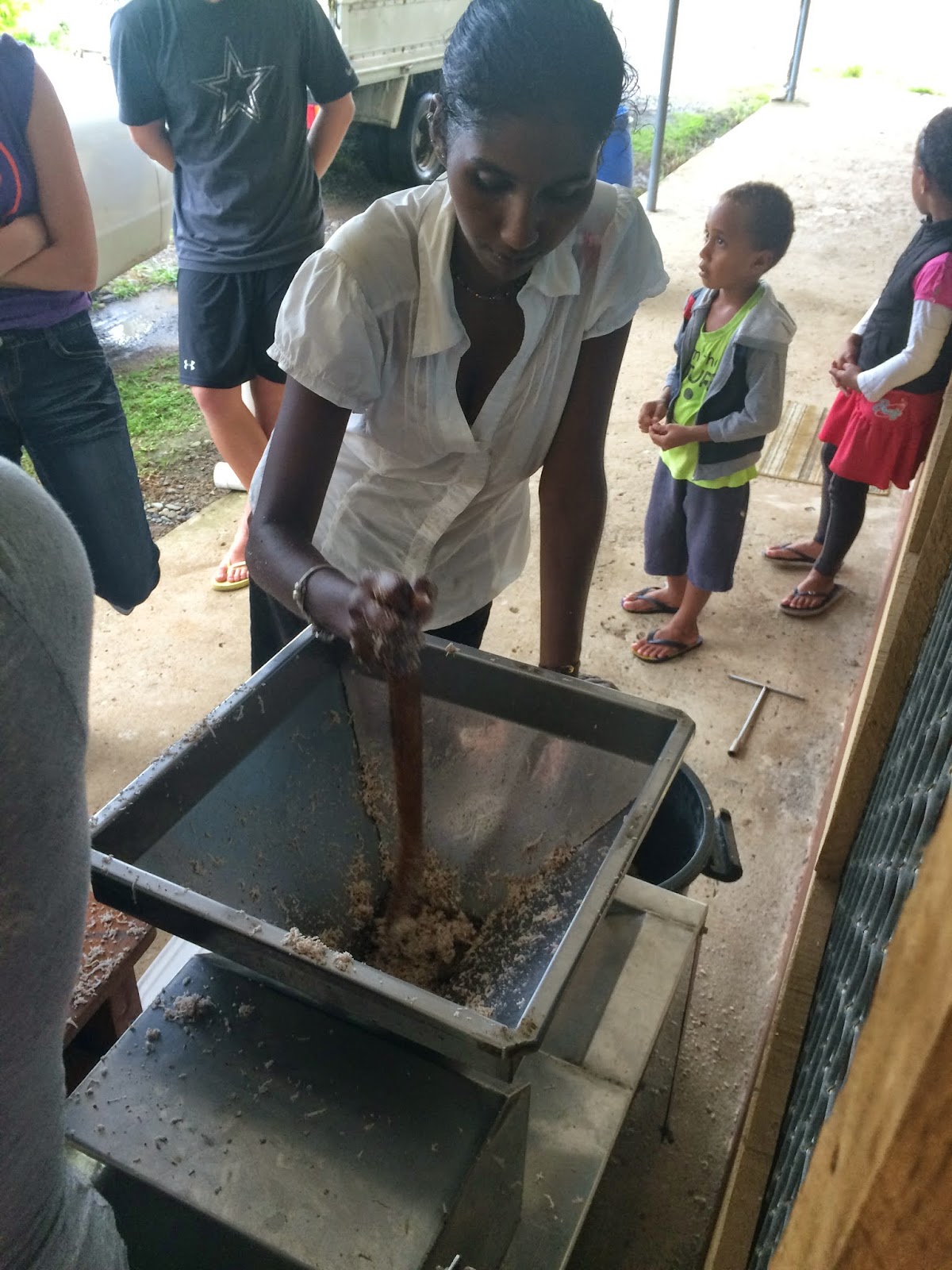
After all 150 coconuts are shredded, the coconut flakes are squeezed through this machine 3 times to produce coconut milk. 


It was amazing to see how much liquid came out of that barrel of coconut flakes. Probably 90% of the coconut meat is water. 
This is a coconut that can grow another coconut tree. A little bud grows on the top and uses the water from the coconut to grow that thing in the middle. We all got to eat some and it was so weird. It had the weirdest texture it was like wet Styrofoam. 

After the milk is produced, in order to get the best quality oil, you need to leave it in the sun or inside a warm place with humidity so it can separate. Then you have to spoon out the coconut creme to get to the oil. Finally, you have to filter the oil and pour it into the bottles! The three different bottles are all coconut oil but they look and smell differently based on what process you use. The process we used creates the most purified oil (on the left)

 Saraswati is so fun. I can't wait to go into the villages to get information about how they are making a living through coconut oil processing and bee keeping.


Saturday, February 28, 2015

This week was so busy but so fun. On Tuesday I went to help with FENC. The kids have learned so much since the last time I was there thanks to our team. I learned more about FENC this week so I thought I'd share some statistics. Out of the group of students we teach, only 50% will graduate college. Of those 50% only 5% will go on to University. (in Fiji, High school is called college and college is called University) University tuition here costs $3,000 a semester. The average income of the kids' parents in Nanuku village is about $5,000 a year. That's about $100 a week for a family of 5 and maybe two grandparents. The people in this village are squatters so they do not get help from the government in anything because technically they are there illegally. When it rains, their houses get completely flooded because they basically live in a swamp. The children typically get Scabies and Ringworm at a very young age and are very unhealthy. FENC is probably their only hope in getting out of that village. The only way they can go to university is through academic scholarship. I didn't realize how important our job here was until I found out about the situation these kids are in. We are implementing a classroom management technique called IOL into our classes. IOL stands for inside-out learning. It teaches teachers to use certain management techniques to control their classes so the students can learn at a better pace. I am really excited to see how we can impact FENC and the kids we tutor so they can have a better opportunity at higher education.

Wednesday, February 18, 2015

Here's the "Buzz" on what happened yesterday


Yesterday was the best day yet! We went to Nausori to talk with our partner Saraswati. I don't remember if I explained Saraswati, but it is a college and a small business for helping farmers create their own jobs through beekeeping and Coconut Oil making. We had the opportunity to make our own honey! First we learned about the process through a series of videos and a booklet so that we could better understand what the members of Saraswati do for a living. After the bees have made the honey and covered it in wax to keep it from dripping everywhere, I got to scrape off the wax to reveal the honey underneath. The video is too large to load on here so here is a link to view: Click Here to view video. The bees are so cute when they are first born. We got to see one climb out of it's little honey comb. As soon as they are hatched, they go right back in and clean out the pocket so that the other bees can fill it with honey. The baby bees don't have developed stingers so we got to hold them. They were so fuzzy!
This is what the hives look like when they still have wax on them (they call this stage "capped frames")


After this process is complete, You have to use an extractor to get all the honey from the frame. The extractor is a little machine that you put the frames into and it spins really fast so all the honey sticks to the sides and then drips down. After that, you have to filter the honey to make sure you don't get any beeswax with it. To do this, you need a little mosquito net strainer.
After all the honey has filled the bucket, you jar it up and you have honey! They say that the darker the honey, the more valuable because that means it was harvested locally. I guess that means we got some pretty great honey!
 I learned so much and I have so much respect for bees now. They are crazy hard workers! They literally have a little colony and they choose who is going to be queen and when the queen is sick, they make a new bee the queen. Queen Bees are just fertile bees. Drones are the male bees and their only purpose is to mate with the queen and then they die. Worker bees are all females who are not fertile. When the bees make a queen, they eat some honey and then regurgitate it onto the larvae to give it more nutrients and create a queen bee. The stuff they throw up is called royal jelly and people buy it and turn it into pills and take it! Apparently there is a HUGE market for royal jelly. And I guess it tastes like yogurt too.. I don't want to know why original bee keepers thought it was a good idea to eat bee throw up but whatever. On our walk back home, we pass this: 


Fiji is so gorgeous and I am so excited to see what other projects we get to do with Saraswati. Next week we will be learning how to make coconut oil so stay tuned!